Home › Blog › How to Meet People on a Solo Trip
How to Meet People on a Solo Trip
Last updated: September 18, 2026
Practical, low-effort ways to meet other travelers on a solo trip, from choosing the right room to keeping your plans loose enough to say yes.
Published · Updated
Quick answer
How to meet people on a solo trip comes down to one habit: choosing shared spaces on purpose — a hostel common room, a group tour, a day trip — instead of waiting for a conversation to happen by chance.
Key takeaways
- Shared spaces — hostel kitchens, dorms, group tours — create conversations better than luck does
- Ask easy logistics questions instead of clever openers; proximity does most of the work
- Book only your first night or two so you can change plans around people you meet
- Keep one unplanned day a week free for whatever a new travel friend suggests
- Check in with someone back home on a schedule — it supports being social, not against it
How to meet people on a solo trip comes down to one habit: put yourself in shared spaces on purpose — a hostel kitchen, a group walking tour, a day trip — rather than waiting for a conversation to happen on its own. Showing up to the right spot does more of the work than any personality trait.
Where do solo travelers actually meet people?
It's rarely a museum queue or a train seat, even though that's the scene most people picture before their first trip. It's almost always somewhere with a shared task and no pressure to perform: a kitchen where two people are cooking at the same time, a rooftop where everyone's just killing the evening, a tour where the group has already formed before anyone has to introduce themselves.
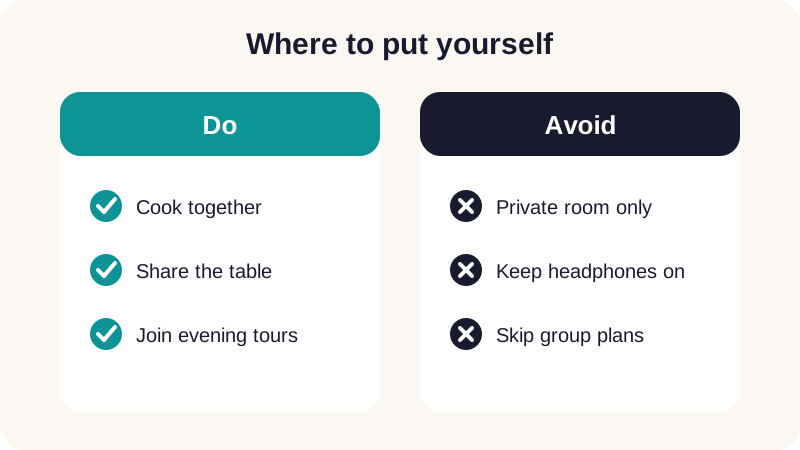
A shared dorm room puts more strangers in the same space at the same time than a private room does, which is exactly why dorms are generally considered more social, even for people who'd normally pay for privacy. If meeting people is the actual goal for a leg of your trip, a dorm bed for a few nights does more of that work than any personality trait ever could. Many hostels also run a free walking tour, pub crawl, or other group activity most evenings, which exists specifically to solve the "how do I start talking to someone" problem for you — you just have to show up.
For a longer breakdown of picking the right building for this, see how to choose a hostel for socializing.
What do you actually say to start a conversation?
Almost nothing clever is needed. The lines that work are boring on purpose, because they give the other person something easy and specific to respond to.
- "What are you making?" — said to whoever's cooking near you in a hostel kitchen.
- "Have you figured out the bus to [wherever]?" — a logistics question gives the other person a useful answer and a reason to keep talking.
- "Mind if I sit here?" — asked at the communal table, not the empty corner one. Proximity does most of the work before you've said a word.
- "Are you going on the walking tour tonight?" — turns a solo evening into a shared plan with zero awkwardness.
None of this requires being outgoing so much as it requires showing up to the right spot at the right hour. The same habits that work here apply whether you're on a two-week trip or a six-month one — more on that in how to make friends backpacking solo.
How do you turn one conversation into an actual travel plan?
This is the part people underestimate. Meeting someone at breakfast is easy compared to deciding whether to actually spend the day together, and that decision mostly comes down to how locked-in your own schedule already is.

- Meet someone in a shared space — a kitchen, a tour, a communal table.
- Ask what they're doing next, loosely, not as a commitment.
- Suggest one small, specific thing: a market, a hike, dinner.
- If it's going well, keep your own bookings loose enough to extend it.
Booking only the first one or two nights of a trip, rather than the whole stay, is a common way solo travelers keep things flexible enough to change plans around a person rather than a schedule. A home base with day trips out — staying in one city and visiting nearby places rather than moving every night — helps too, since it gives you multiple days in the same spot to run into the same people again. If you'd rather line someone up before you even land, finding travel companions online is worth doing alongside meeting people in person, and it pairs well with a loosely built solo trip itinerary.
How do you add structure without losing the flexibility that makes this easy?
Group tours and day trips organized locally, rather than booked from home, are a common way to add a bit of structure to part of a trip without giving up spontaneity. You show up, you're in a group of strangers for a few hours, and you leave with at least one new contact — then your evening is still entirely open. For how this usually works for a single traveler, see joining a group tour as a solo traveler.
Keeping one mostly-unplanned day per week is worth building into any itinerary, solo or not. It's the day you're most likely to say yes to whatever someone else suggests, which is usually where the better stories come from.
Budgeting also gets easier once you're traveling with people some of the time. Splitting a trip budget into fixed costs (flights, pre-booked stays), daily costs (food, local transport), and a buffer is a common approach, and shared activities — splitting a taxi, cooking together instead of eating out solo — tend to shrink that daily number without any extra planning.
How do you meet people while still traveling safely?
Being social and being careful aren't in tension. They mostly support each other.
Checking in with a friend or family member on a set schedule while traveling is a widely recommended habit, and it costs nothing: a short message every couple of days so someone always has a rough idea where you are. For a simple system, see how to check in with family while traveling. Trust your own read of a person and a situation the same way you would at home — unfamiliar surroundings don't make your instincts less reliable, they just make you less used to listening to them.
This is also the problem Tramigo is being built around. Planned features include Find Nearby Travelers, for spotting other travelers near you once the app eventually launches, Group Meetups for joining or starting something like a hike or a food crawl, and Safety Check-ins for sharing your location with people you trust, alongside Travel Stories and crowd-sourced Destination Guides for figuring out where to go next. Tramigo hasn't launched yet, so there's nothing to download today, but it's planned to be free to download with optional paid features. You can sign up on the homepage to be notified when it opens.
Meeting people while traveling alone isn't about being naturally outgoing. It's about choosing places built for it — the right kind of room, the right kind of tour, a loose enough plan to say yes — and showing up. The rest tends to take care of itself.
Frequently asked questions
What's the easiest way to meet people on a solo trip?
Hostel common areas — kitchens, lounges, rooftops — plus group walking tours and local day trips are easiest, since they put you in a shared task with other travelers without anyone needing to make the first move. A shared dorm room multiplies those chances further than a private room does.
What do I actually say to start talking to a stranger while traveling?
Keep it boring on purpose: ask what someone's cooking, whether they've figured out the bus to somewhere, or if they're joining tonight's walking tour. A logistics question gives the other person an easy answer and a reason to keep talking, and it works better than anything clever.
How do I keep my itinerary flexible enough to travel with people I meet?
Book only the first night or two of your trip, keep one unplanned day a week, and consider a home base with day trips instead of changing cities nightly. All three let you say yes to a new travel companion without unraveling the rest of your plan.
Is it safe to meet strangers while traveling alone?
Meeting people in shared public spaces first — a common room, a tour group, a communal table — and checking in with someone back home on a set schedule covers most of the practical habits that matter. Trust your own read of a person the same way you would at home.
Will Tramigo help me meet other travelers?
Tramigo is a planned app for solo travelers that aims to help you find nearby travelers, join group meetups, and share safety check-ins once it eventually launches. It hasn't launched yet, so there's nothing to use today, but it's planned to be free to download with optional paid features, and you can sign up to be notified when it opens.